Michael & Roberta Joint Timeline
This timeline below shows Michael & Roberta's share history, important dates, and events.
We have collected key events but this is not a complete history and we encourage you to use this timeline as an initial source for further research.

Search our timeline for key phrases or dates with ease by pressing CTRL F on your keyboard. Alternatively, click on the bullet points below to go to a particular time period.
This timeline is broken down into the following periods:
Michael
Roberta
Michael Dillon is born (1st May 1915)
Michael is born in Ladbroke Grove, London.
Roberta Cowell is born (8th April 1918)
Roberta is born in Croydon to Major-General Sir Ernest Marshall Cowell (1886–1971) and Dorothy Elizabeth Miller (1886–1962).
1940
Laura McCliver dies (11th May 1915)
Michael's mother, Laura Maude McCliver, nee Reese, dies from sepsis.
Sent to live with aunts (July 1915)
Michael and older brother Bobby, aged 15 months, are brought to live with their father’s maiden sisters in Folkestone, Toto and Daisy.
Hair cut incident (1920)
'I want my hair cut like Bobby's': Out of the Ordinary, p. 46
'One morning we were being dressed to go to the barber when I inadvisedly said: "I want my hair cut like Bobby's." Nanny only laughed and said: "Don't be silly, you can't, you're a little girl and he's a little boy." When we were at the hairdressers, some devil prompted her to say: "Tell the barber what you said in the nursery." Embarrassed, I tried to pretend I had forgotten, but she persisted so at last I came out with it defiantly: "I want my hair cut like Bobby's." They both laughed uproariously, as I knew they would, and it remained as a bob with either a slide or a ribbon'
Robert Dillon dies (6th October 1925)
Michael's father, Robert Arthur Dillon, dies of pneumonia complicated by alcoholism. Bobby becomes 8th Baronet of Lismullen. Aunt Toto and Mrs Hearne, a friend of his father's, are appointed joint guardians of Michael and Bobby.
'No two worse choices could possibly have been made'
Public School (1928 - 1936)
Roberta attends Whitgift School, a boys' public school in Croydon. She is teased for her weight and perceived feminine body type, and is nicknamed 'Circumference' and later 'Bottom'.
As a teenager, Roberta is interested in mechanics and spends most of her spare time in engineering workshops. She wants to become a racing motorist and design her own cars, and is an enthusiastic member of her school's Motor Club. A fellow member of the club, John Cunningham, will go on to be a famous RAF night fighter ace and test pilot.
Ruptured Appendix (1931)
Roberta suffers from acute appendicitis and a ruptured appendix, and is given emergency surgery by her father.
Gate Incident (1933)
'He thinks I'm a women': Out of the Ordinary, p. 73
'One afternoon I was out for a walk with the eighteen year old nephew of the Vicar who had gone up to Oxford the term before. We came up the cliff from the sea and somewhere there was a gate which he opened and stood aside to let me pass through first. Suddenly I was struck with an awful thought, for no one had done this for me before. "He thinks I'm a woman." It was a horrible moment and I felt stunned. I had never thought of myself as such despite being technically a girl. I finished the walk in silence, the silence of despair, and he never knew what he had done to upset me. But life could never be the same again. People thought I was a woman. But I wasn't. I was just me. How could one live like that? With no one to ask I brooded long on this at nights in bed'
Employed at Gloucestershire Lab (1939)
After graduating from Oxford, Michael works at a lab in Gloucestershire.
Begins motor-racing (1935)
Roberta gains initial experience of motor-racing by sneaking into the area where cars are serviced at the Brooklands Race Circuit dressed in a mechanic's overalls and offering help to any driver or mechanic who wants it. She begins competition work as a driver as soon as she is legally old enough to drive on the road, after her seventeenth birthday. She quickly gains success as a racing driver.
In her autobiography, Roberta claims that her transition caused her to lose all interest in racing. She writes that her psycho-analysis revealed that 'to me racing was a symbol of courage, power and virility', and that 'when I finally knew the full truth about myself, the tremendous and all-powerful enthusiasm for motor-racing vanished completely'. However, she will return to racing only a few years after her transition, and make another attempt to stage a comeback as a driver in the 1970s.
European travels (1935)
Towards the end of her school years, Roberta visits Belgium, Germany and Austria with a friend from school. She is briefly arrested in Germany for filming Nazi drills, and is released when she promises to destroy the film- however, she manages to substitute the film with unused film stock, and gets away with the footage intact.
Begins studying at UCL (1936)
Roberta studies engineering at University College London.
Becomes RAF acting pilot officer (4th August 1936)
Roberta joins the R.A.F. as a pupil pilot. Her initial training is at Desford, near Leicester, and she is the youngest officer in the Service at the time. However, she struggles with nausea while flying and is discharged due to airsickness.
Competes in Antwerp Grand Prix (1939)
Enlists in the Royal Army Service Corps (1940)
Begins writing 'Self: A Study in Ethics and Endocrinology (1st January 1939)
Michael begins working on the book that would become Self: A Study in Ethics and Endocrinology. TFMMM p53-54 (1941)
OFTV 14:30 ‘He writes for gender self-determination, the idea that we can only know a person’s gender by asking them. The book also argues for better treatment for intersex children.’ TFMMM p. 53
'Surely, where the mind cannot be made to fit the body, the body should be made to fit, approximately, at any rate to the mind, despite the prejudices of those who have not suffered these things, yet to suffer which they so readily condemn others.’ p. 53
Michael sees Dr Foss and begins taking testosterone. Moves to Bristol (approx. 1st January 1939)
Michael seeks treatment for gender dysphoria with Dr George Foss, a Bristol GP. Morgan M. Page, One From The Vaults:
'Foss had been experimenting with testosterone on women for the past two years, in hopes of curing menstrual problems... he had some success. The lowered voices and body hair and increased clitoral size he chalked up as easy side effects that shouldn’t concern anyone. But here was Michael Dillon, demanding to use the drug to effect a sex change. He was intrigued, but required Michael to go see a psychiatrist friend before he would prescribe the hormones.'
Michael did, and when he returned to the office a few days later, he found Dr. Foss nervous. Suddenly the doctor didn’t want to help. But he handed over a bottle of testosterone pills and said that Michael could try dosing himself.’
‘Michael Dillon kept a meticulous log of doses and associated changes as he self-administered testosterone, providing the very first medical research into FTM testosterone usage. He was well-equipped to do this, working in a medical lab and with an Oxford education'
Michael works at a garage and begins fire watching (1940 - 1945)
Now taking testosterone but still with female identity papers, Michael begins to work at a Bristol garage. While working there he meets Gilbert Barrow, who defends him from harassment by other employees and tells him:
‘You’re a bloke as far as I’m concerned'
They become lifelong friends. In his autobiography he describes this period as:
'the nadir of mental suffering'
a crossed-out note in pencil reads:
'It [working in the garage] was the worst period of my life'
Hospitalised due to hypoglycaemic blackout and fall (June 1942)
Baedeker Blitz on Weston-Super-Mare unfolds while Michael is in the hospital there recovering from a hypoglycaemic blackout and fall.
Second blackout and fall (approx. December 1942)
Michael suffers a second blackout and fall, and is taken to the Royal Infirmary. There is confusion over what ward to put him in, as he still has female documents. When he wakes up, an unnamed Quaker surgeon tells him he will help take care of his problem - he introduces him to a plastic surgeon to remove his breast tissue, and says he will put him in touch with Sir Harold Gillies for further surgery. He also suggests 'getting reregistered', i.e. having his documents changed to male.
Bilateral mastectomy (approx. December 1st 1942)
Michael undergoes a double mastectomy
Marries Diana Margaret Zelma Carpenter (29th May 1941)
Roberta marries Diana Margaret Zelma Carpenter, known as Zelma, who had also been an engineering student at UCL and is interested in motor racing. Zelma is the first woman to graduate from UCL with an engineering degree. She describes the marriage as unhappy, and makes only infrequent reference to it in her writings, calling it:
'an episode in my life which is best forgotten'
First daughter Anne is born (July 1942)
Roberta had two daughters with her wife, Anne and Diana. In her autobiography, Roberta Cowell's Story, she suggests that the fact that both her children were female supports her claim to have an underlying intersex condition. She otherwise mentions her children very little in her writing, and after her transition never saw or spoke to either of them again, although she claimed to have a 'very strong maternal instinct' after her transition and frequently spoke of the possibility of having children as a woman.
'My marriage had been unhappy; in spite of our two little girls (the elder born in July, 1942 and the younger in August, 1944) there had been an underlying air of falseness about it. It is difficult and painful for me to say much about this marriage. But it must be clear from the way we lived— our house was at Hove, in Sussex, and I worked 53 miles away, commuting by car seven days a week, with a weekly trip to Manchester, 290 miles away, thrown in—that the two paths of marriage never joined for very long in our case, and that the rocks between them were very high indeed'
Joins the RAF (24th January 1942)
Roberta transfers from the Army to the RAF with the rank of pilot officer (temporary). She had obtained a private pilot's licence before the war and completed RAF flying training at RAF Ansty.
She serves a tour with a front–line Spitfire squadron and then briefly as an instructor.
Second daughter Diana is born (August 1944)
First visit to Dr. Harold Gillies at Rooksdown (1943)
Michael travels to Basingstoke to meet Harold Gillies, who agrees to operate on him after the war.
Re-registration as male (1943)
Michael goes to the Labor Exchange to have his identity card re-issued in his new name and gender. Out Of The Ordinary extract:
'With the poker face back on and on the defensive I went to get a new identity card at the Labor Exchange, prepared for grins and curiosity'
‘Oh, yes,’ said the man behind the counter, ‘we have had quite a lot of these applications’, and made me out a new card without batting an eyelid! How common was it? I am none the wiser on that point now'
'Then I automatically received my call-up papers for the Army although I was told that the medical examination would be a mere formality. ‘Yes’, said the Army doctor, ‘we’ve turned down a lot like you’
Birth certificate amended (14th April 1944)
A doctor in Bath, John Cooper, signs a medical certificate saying Michael is 'far more male than female' and wished to adopt that sex permanently.
A certificate from a member of the family was needed for re-registration at the registrar of births, marriages and deaths- Michael writes to a cousin, Maude Eileen 'Minnie' Beauchamp, who agrees to sign the certificate. Michael sends the application to Somerset House and is accepted.
Michael's birth certificate is amended by a marginal note which reads:
'In entry no 54 col 2, for Laura Maud read Laurence Michael and in col 3 for 'girl' read 'boy'. Corrected on 14th April 1944 by C. E. Weston, Supt Registrar on production of a statutory declaration'
Informs aunts and brother of transition (approx. 14th April 1944)
Michael tells his aunts about his transition with help from a 'woman doctor' friend of the aunts, Alison Macbeth (who would later help with Roberta Cowell's transition). They grudgingly accept it.
Michael meets his brother in the restaurant of the Savoy cinema in Dublin. He refuses to accept him as his brother or to acknowledge him in any way, and forbids any further contact (although Michael did have a somewhat friendly relationship with his wife Lady Synolda Dillon.) Michael proposes that they pass him off as Robert's 'cousin', in order to continue having a relationship, but Robert rejects this.
University records amended (8th September 1944)
With help from Jimmy McKie, Michael's name is moved from the records of St Anne's (then a women's college) to Brasenose (a men's). His degree certificate is re-issued with just his initials, 'L.M. Dillon'. Out Of The Ordinary extract:
'It was due to the kindness and common-sense of my ex-tutor that my name was transferred to the books of Brasenose College where I had learned all my philosophy, and also that the Oxford University Registrar was persuaded to issue me an M.A. certificate with only my initials in place of my first names. Jimmy McKie then composed a masterpiece of a reference, which did not use any pronoun whatsoever and yet was perfectly grammatical and readable.'
Spitfire malfunctions (4th June 1944)
Flying with No. 4 Squadron RAF, a squadron assigned to aerial reconnaissance, the oxygen system of her Spitfire malfunctions at 31,000 feet over Fruges, France.
Roberta passes out, but the aircraft continues to fly on its own over German-occupied France while being subjected to anti-aircraft fire.
She regains semi-consciousness and is able to fly back to base.
Spitfire crash and capture (18th November 1944)
Roberta's plane is hit by anti-aircraft fire near Bocholt, Germany.
She is able to glide it to a crash-landing and radios her companion to confirm she is unhurt before being captured by German troops.
She tries and fails twice to escape, but is taken further into Germany, spends several weeks in solitary confinement at an interrogation centre for captured Allied air crew, and is then taken to the prisoner-of-war camp Stalag Luft I.
Time as a POW at Stalag Luft I (December 1944 - May 1945)
Roberta is a prisoner of war at Stalag Luft I for around five months; during this time, she runs automotive-engineering classes for fellow prisoners.
She witnesses homosexual behaviour between fellow prisoners, and refuses with horror when she is propositioned herself. Her autobiography stresses many times her antipathy towards homosexuals and anything perceived as 'sissy'. At one point she is asked to play a female role in the camp theatre, but refuses without hesitation.
Towards the end of the war, food becomes very scarce in the camp. Roberta loses fifty pounds, and later describes killing cats and eating them raw in desperation. Stalag Luft I is liberated by the Red Army on 30th April 1945.
Commonwealth personnel are flown back to the United Kingdom between the 12th and 14th of May.
Medical student at Trinity College, Dublin (1945 - 1951)
In Autumn 1945 Michael begins medical school at Trinity College, Dublin. He once again takes up rowing, this time on the men's team.
https://heartheboatsing.com/2025/02/13/dr-dillon-making-history-part-ii-michael-dillon-revisited/
Out Of The Ordinary extract:
‘The world began to seem worth living in after all...It was the first time I was able to start among people who knew nothing whatever about me and accepted me as an ordinary man. The relief was indescribable.’ ‘With girls one had to be careful...I developed something of a reputation of being a woman-hater, since I made a point of treating them in a rather rough brotherly fashion, and sheered off if any showed any signs of being interested. One must not lead a girl on if one could not give her children. That was the basis of my ethics. An evening’s flirting at a dance was one thing and a relief- but no more.’ Added by hand: ‘Yet often I felt resentful that I should always be alone, and never have [several words crossed out and illegible]’
Michael's book 'Self' is published by Heinemann (1946)
https://archive.org/details/self-a-study-in-ethics-and-endocrinology-by-michael-dillon/mode/2up
Series of at least 13 phalloplasty surgeries (1946 - 1949)
Between 1946 and 1949, Michael undergoes a series of at least thirteen phalloplasty surgeries by Dr. Gillies at Rooksdown, in his vacations between terms at Trinity. Out Of The Ordinary extract:
'Every vacation for my first four years was spent in hospital. On the evening of the last day of term I would fly over to London and take the train to Basingstoke, arriving at midnight and as often as not my operation would have been scheduled for the morning'
Returns to racing (1946)
Roberta returns to racing and competes in as many events as possible
Starts engine prototypes firm (1947)
Following a dream of designing an engine that would win the Grand Prix, Roberta starts an automobile engineering firm called Cowell and Watson with a friend, putting in thousands of pounds borrowed from her parents.
Separation from Zelma (1948)
Roberta and Zelma separate; Roberta never sees either of her daughters again.
Seeks psychiatric help (approx. 1948)
Although she has thrown herself back into racing, Roberta feels that her life is 'pointless and empty'. She becomes depressed, loses weight, and eventually decides to go to a psychiatrist. After working with several different analysts, she eventually sees one who gives her a series of tests, including word association and ink-blot tests. These tests, according to her autobiography, demonstrate that her 'unconscious mind' is female:
'The biggest shock my personal esteem got was when I discovered that my unconscious mind was predominantly female. Not only was it clearly shown by the tests, and the evidence was far too obvious to be denied, but as the analysis proceeded it became quite obvious that the feminine side of my nature, which all my life I had known of and severely repressed, was very much more fundamental and deep-rooted than I had supposed.’
Seeks psychiatric help (approx. 1948)
Roberta visits a famous sexologist in Harley Street, who, she claims:
'gave it as his considered opinion that my body showed quite prominent feminine sex characteristics' and 'there was a possibility that I had some feminine organs inside my body'
She briefly considers ending her life, in part for eugenicist reasons:
'According to [P. D.] Ouspensky one of the chief signs of racial degeneration is a weakening of the distinguishing marks of the male and female. In my own case my secondary sex characteristics were poorly developed and I had some female characteristics. It seemed to me that here was a strong moral argument for putting an end to my life'
However, the understanding that her femininity has some biological basis also alleviates Roberta's feelings of shame:
'I found that this knowledge raised my morale very considerably. The intense shame I had felt began to disappear. Once I realised that my femininity had a substantial physical basis I did not despise myself so much. True, I now knew I was physically abnormal, but at least I could accept a degree of femininity without losing self-respect’
She begins to consider transition, although she is determined not to 'swell the ranks of the gentlemen of no particular gender' (i.e. homosexuals).
Roberta meets Lisa Morrell (November 1948)
Roberta meets Lisa Morrell, who will become a lifelong companion. They quickly become close and Roberta tells Lisa about her struggles with her gender only a few days after their first meeting. They decide to move in together, and because Roberta is still presenting as a man, Lisa adopts the identity of Roberta's 'wife'. She appears as 'Elizabeth Cowell' on the 1952 voters' list. The exact nature of their relationship is not fully known, although a friend of Roberta's will later claim that they were romantically involved before Roberta's physical transition.

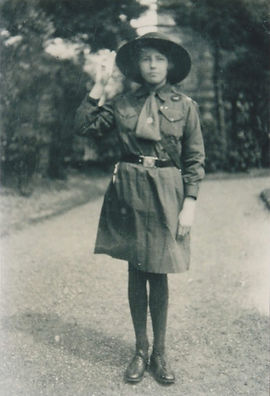

(Michael Dillon as a scout, 1931 (approx.). Credit: Liz Hodgkinson)
(Michael Dillon pre-transition, in his hometown of Folkestone, 1931. Credit: Liz Hodgkinson)
(Michael Dillon pursuing qualifications to become a doctor, 1944. Credit: Liz Hodgkinson)

(Michael Dillon in Neptune Rowing Club racing kit,
1949. Credit: The Bristol Magazine

(Roberta in WWII. Date unknown)
Begins taking oestrogen (approx. 1949 - 1950)
Around 1949 - 1950, Roberta begins taking oestrogen, although she is still living as a man. She begins to be treated by Alison Macbeth, the doctor who helped Michael explain his transition to his aunts, who she describes as 'a brilliant woman doctor, a specialist in glands'. She undergoes repeated examinations by gynaecologists and endocrinologists, and writes that:
'my case was a very unusual one indeed, apparently unique of its type, certainly as far as British medical history went'

(Roberta Cowell pre-transition, posing for a photo when she worked as a WW2 Spitfire pilot, 1947. Credit: https://www.digitaltransgenderarchive.net/files/p8418n42m)
Initial correspondence between Michael and Roberta (approx. 1949)
Michael receives a letter via his publisher from someone who has read his book Self and identifies herself as having the 'condition' Michael wrote about. This person, Roberta Cowell, expresses interest in meeting Michael. Although initially cautious, Michael agrees. A lunch is set up in London.
1950
First in-person meeting between Michael and Roberta (approx. 1st Jan 1950)
Michael and Roberta meet at a restaurant for the first time. Although Michael doesn't initially intend to tell Roberta about his trans history, he is smitten by her and ends up blurting it out after an hour. She tells him about her struggles to transition and he promises to help her access surgery and legally change gender.
Further correspondence (throughout 1950)
Michael and Roberta begin exchanging frequent letters, with him sometimes sending multiple letters a day. Although her letters have not survived, it is clear from Michael's side of the letters that, at the very least, she allows him to believe they were in a romantic relationship. She sends him glamorous photos of herself, which he displays proudly in his flat and showed to friends. He brings Roberta to Folkestone and introduced her to his aunts as his soon-to-be fiancée.
Michael's letters to Roberta show an entirely different side of him to the rather stiff, reserved tone of his published writings. Many of the letters are signed with rows of kisses- one has a doodled heart with 'Michael loves Bobbie' written around it. He talks about wedding plans, including potential venues. Although they were not yet officially engaged, he clearly believes there is an understanding between them that this will happen. He plans to propose officially once he has passed his final exams and qualified as a doctor.
"No inhibitions are going to stop me saying, I love you. I love you with the whole of me. Te amo, ergo habebo te, Q.E.D?'
Dr Gillies declines to operate on Roberta (approx. 1950)
Although Dr Gillies wanted to help, he felt unable to operate on Roberta because to do so would have been illegal and he would have risked losing his license. A centuries-old law known as mayhem law forbade amputating the testicles, or any other healthy body part, of any 'man' who might become a soldier. Michael had had no such issues with his medical transition, because there were no laws against operating on, changing, or removing parts of the 'female' sexual organs. Without the orchidectomy (removal of the testicles), Roberta could not legally change her sex, which made it impossible for Michael and Roberta to legally marry.
Agreement for Michael to operate on Roberta (approx. 1950)
Unable to find a surgeon who would remove Roberta's testicles, Michael and Roberta finally decided that Michael, still a medical student, would perform the operation himself. They drew up a written agreement, in the hope of giving Michael some legal protection if Roberta died during or as a consequence of the surgery:
'I, R.C. have, of my own free will asked and persuaded L.M.D., who I am aware is an unqualified man, a 5th year medical student, to perform an orchidectomy upon me. I am also aware that his operating experience has been confined solely to assisting at operations as a resident pupil in the hospital and to one appendectomy in the presence of a surgeon and that he has neither seen nor practiced this particular operation. I desire that he be absolved from all responsibility in this operation, due to possible hemorrhage or sepsis, which I am desirous to undergo being fully aware that either might, per fortunam, be fatal.'

Michael operates on Roberta (1950)
Michael performs an orchidectomy on Roberta on the kitchen table of Alison Macbeth, the doctor who had helped him explain his transition to his aunts years previously, and who had helped Roberta in her transition.
In one of his letters to Roberta he mentions quoting a hymn, 'Father, hear the prayer we offer', during 'The Op':
'Be our strength in hours of weakness, In our wanderings be our guide, In endeavour, failure, danger, Father be thou at our side.'
Michael places the amputated testicles in a jar of formaldehyde, probably at the behest of Gillies, who will later examine them. The First Man-Made Man extract:
'Dillon placed the amputated testicles in a jar of formaldehyde for further study. He may have done this at the behest of Sir Harold Gillies, who would later examine the sample; in Gillies's case study of Roberta Cowell, he suggests that he knew full well that Cowell had been castrated in England, in violation of the law. When Gillies studied the testicles many months later, he declared them atrophied- not surprising, since Cowell had been taking high doses of estrogen for two years. Because the testicles would not have been functional, Gillies argued that "had the castration been performed in Great Britain, the law of mayhem in reference to mutilation would not have applied." The fact that Gillies dropped this sentence into his study of Cowell indicates that he knew exactly how and where she'd lost her testicles, and that he thought it necessary to protect Dillon and himself from prosecution under the law.'
Birth certificate changed (18th May 1951)
Roberta is examined by Dr Georges Dusseau, who determines she is female and agrees to write the note declaring her to be intersex which will allow her to legally change her sex.
On the 18th of May 1951, Roberta is able to have her birth certificate re-issued as a female.
Michael sends Roberta a ring in a cigarette package (approx. 1st June 1951)
With Roberta now able to legally change her sex, Michael sends Roberta a ring in an empty Players' cigarette package. He instructs her to put it in a drawer and not to open it until he has passed his final medical exams, which he is worried he might fail.
Qualifies as doctor and obstetrician (approx. 1st July 1951)
Michael passes his final exams at Trinity College. He writes to Roberta and tells her to open the package with the ring.
Roberta rejects Michael's proposal (approx. 1st July 1951)
After a period of not responding to his letters and seeming to avoid him, Roberta rejects Michael's proposal. They meet one last time and she explains her reasons.
Years later, she says that she never regarded him as a real man:
"As far as I was concerned, it would have been two females getting married, and I was certainly not interested in him in that kind of way"'
Accepts 1yr residency in Dublin hospital (1st July 1951)
Having not done as well in his exams as he had hoped, Michael accepts a year's residency in a Dublin hospital.
Signs up for 1yr tour as doctor on merchant-navy ship (1952)
Michael signs up for a tour as a doctor on a merchant-navy ship sailing across the Red Sea
Visits editor of Debrett's Peerage (1953)
Michael visits the editor of Debrett's Peerage in London, shows him his birth certificate and asks for his entry to be amended- i.e. for him to be listed as Bobby's brother (and therefore heir to the baronetcy), rather than his sister.
The editor, C. F. Hankison, agrees not only to correct the entry, but also to back Michael as the next baronet if Bobby dies first. He assures Michael that once the change appeared in Debrett's, Burke's Peerage would do the same however, this did not happen. The discrepancy would go unnoticed for five years.
Signs 4yr ship contract (1954)
Michael signs a four year contract with a ship ferrying Muslim pilgrims to Mecca.
Signs 4yr ship contract (1954)
In his correspondence with Dr. Gillies, Michael and Gillies make a series of references to someone who seems to be another trans person Michael has introduced to Gillies, and whom Gillies is treating. Outside of Roberta and his friend from university, this is the only other known example of Michael being in contact with another trans person.
22/06/54 Michael to Gillies: 'Can you try and remember to let me know about that girl --> man I saw- what the progress is?'
12/11/54 Gillies to Michael: 'I thoroughly agree that it would be a good plan to remove the remains of that uterus, and I will ask our general surgeon whether he is willing to co-operate with us in the matter. If he gibs, then I shall have to arrange for you to be handled by somebody else and I think I should first approach one Cook of Bristol. He has just removed the breast of Robertson whom I am 'changing'
11/12/54 Michael to Gillies: 'I think a gynaecologist is essential though it will probably tickle him pink to do such a job on such a patient. As I don't believe any uterus has been subjected to about 13 years of methyl testosterone 20 milligrams per day before, it will be interesting to see Harrison cut it up and see what effects have been made, if any. Have at last solved the problem I think of why these hypo-glycaemic attacks are prone to occur between breakfast and lunch. Whereas I can go from 12.30 to 7p.m. with no function, food. There must be a 12 hour delayed action as I take them at night at 10p.m. with the result that these [blank] depressent[sic] effect on the adrenal medulla occur in the morning. I have now in the past week changed the time to 2pm and apear to be much safer, although it will be a bit of time before the cyclic effects wear off as it has gone on for so long, But these present tablets are far more depressant than the ......Robertson ought to be warned of the possibility of attacks and to carry glucose tablets about with her' [sic]
28/12/54 Gillies to Michael: 'I note what you say about Robertson'
References to another trans person in correspondence with Dr. Gillies (22nd June 1954 - 28th December 1954)
In his correspondence with Dr. Gillies, Michael and Gillies make a series of references to someone who seems to be another trans person Michael has introduced to Gillies, and whom Gillies is treating. Outside of Roberta and his friend from university, this is the only other known example of Michael being in contact with another trans person.
22/06/54 Michael to Gillies: 'Can you try and remember to let me know about that girl --> man I saw- what the progress is?'
12/11/54 Gillies to Michael: 'I thoroughly agree that it would be a good plan to remove the remains of that uterus, and I will ask our general surgeon whether he is willing to co-operate with us in the matter. If he gibs, then I shall have to arrange for you to be handled by somebody else and I think I should first approach one Cook of Bristol. He has just removed the breast of Robertson whom I am 'changing.'
11/12/54 Michael to Gillies: 'I think a gynaecologist is essential though it will probably tickle him pink to do such a job on such a patient. As I don't believe any uterus has been subjected to about 13 years of methyl testosterone 20 milligrams per day before, it will be interesting to see Harrison cut it up and see what effects have been made, if any. Have at last solved the problem I think of why these hypo-glycaemic attacks are prone to occur between breakfast and lunch. Whereas I can go from 12.30 to 7p.m. with no function, food. There must be a 12 hour delayed action as I take them at night at 10p.m. with the result that these [blank] depressent[sic] effect on the adrenal medulla occur in the morning. I have now in the past week changed the time to 2pm and apear to be much safer, although it will be a bit of time before the cyclic effects wear off as it has gone on for so long, But these present tablets are far more depressant than the ......Robertson ought to be warned of the possibility of attacks and to carry glucose tablets about with her' [sic]
28/12/54 Gillies to Michael: 'I note what you say about Robertson.'
Leaves ship contract two years early (1956)
With a growing interest in the spiritual ideas taught by mystics like G.I. Gurdjieff, Michael breaks his contract two years early and returns temporarily to life on land.
Leaves ship contract two years early (1956)
Michael comes across the book 'The Third Eye' by 'Lobsang Rampa', a British man born Cyril Henry Hoskin who claimed to be a Tibetan lama.
He begins a friendship/mentorship with Rampa, who tells him to do one more sea voyage and then look for a monastery where he can learn meditation.
Photo of Dillon with Hoskin here: https://www.st-annes.ox.ac.uk/life-here/library/blog/michael-dillon/
Publishes 'Poems of Truth' (1957)
Michael's book of poetry, 'Poems of Truth', is published by Linden Press. Available online here:
Michael is outed by British Press (May 1958)
While on board his ship, Michael receives a cable which reads: 'Do you intend to claim the title since your change-over? Kindly cable Daily Express.' He realises immediately that his secret is out.
He is told two reporters are waiting for him on the wharf. Knowing that they would publish the article regardless, Michael gives them a brief interview and allows them to take a picture of him. He tells the Captain of his ship, who is sympathetic. When the rest of the crew find out from the newspapers, they are almost all supportive.
Out of the Ordinary: 'Next day I could stand it no longer and I took the bull by the horns and went up to the Second's cabin at twelve o'clock...He and Sparks were in there and I was at once invited in for a drink. I made a direct attack by asking if they had seen the papers and what was their attitude going to be. The Second poured me out a gin, raised his glass and knocked mine and then said that they had discussed it at length over beer the night before and had come to the conclusion that I had had a raw deal and since they had liked me before and I had not changed overnight they saw no reason for letting it make any difference'
The articles point out the discrepancy between Michael's entry in Debrett's Peerage, where he is listed as male (and thus heir to his brother's baronetcy), and Burke's Peerage, where he is listed as female. Much of the coverage is focused on the question of whether or not Michael will inherit the baronetcy in the event of his brother's death. The editor of Debrett's, C.F. Hankison, who Michael met with to change his entry, is quoted in Time magazine supporting Michael's claim:
"I have always been of the opinion that a person has all rights and privileges of the sex that is, at a given moment, recognized"
https://content.time.com/time/subscriber/article/0,33009,936913,00.html
When Michael's ship reaches New York, the ship is surrounded by press and he is told he cannot safely go ashore and that photographers might tear his clothes off in order to get a picture.
In British newspapers only a small handful of articles are ever actually published about Michael (some clippings of which are sent to him by friends and family), but being at sea, he has no way of knowing the extent of the coverage. Furthermore, his upbringing has instilled in him a deep horror of being written about in the press. Feeling that he cannot return to England, and with a desire to pursue his spiritual growth, Michael decides to leave the ship in India and disappear for a few years until any press coverage has subsided.
It is not known how the press became aware of Michael's story. Someone may have stumbled across the discrepancy by accident- however, Roberta was known to leak stories to the press when in need of money, and it's possible the tip came from her.
Sunday Express, 11-05-1958: https://drive.google.com/file/d/1cVPF_WUrFe5hXSE2ZEcN9jL391CaD3J2/view?usp=sharing
Daily Express, 12-05-1958: https://drive.google.com/file/d/1mPNdgp_nIquT_ITaZw8Qmk5s32wMfuQP/view?usp=sharing
Daily Express, 13-05-1958: https://drive.google.com/file/d/1G491AjQFqEm6hC5cYohacdU6mIfGEYjW/view?usp=sharing
Arrival in India (approx. July 1958)
Michael leaves his ship in India and begins living the community of Sangharakshita, a British-born teacher, in Kalimpong, the Triyana Vardhana Vihara. He is given the name Jivaka by Sangharakshita, and begins his serious study of Buddhism.
Michael, now Jivaka, assumes a life of poverty and gives away his inheritance and savings 'to those of my friends and acquaintances who were most in need'. He will live the rest of his life in poverty, surviving on the proceeds of his writing, and often malnourished.
Writing about Buddhism (1959 - 1962)
Jivaka begins writing articles about Buddhism for English-speaking audiences. He goes on to publish a number of books, never mentioning his trans history, including Practicing the Dhammapada (1959), Growing up into Buddhism (1960), and 'Imji Getsul - An English Buddhist in a Tibetan Monastery' (1962).
Interference by Sangharakshita (1959)
Jivaka attempts to be ordained as a bhikkhu. However, his former teacher Sangharakshita intervenes, disclosing Michael's trans history and ultimately leading to the monks forbidding his ordination.
In 1960, Jivaka writes an essay entitled A Critical Study of the Vinaya. Without making reference to his own history, the essay argues for greater acceptance of “deformed people”, “hermaphrodites” and eunuchs, who are forbidden from being ordained at this time.
Michael/Jivaka dies in Dalhousie, India (15th May 1962)
Jivaka collapses while travelling and is taken to the Civil Hospital of Dalhousie. He dies on May 15th 1962, aged 47. The exact cause of death is not known but malnourishment and typhoid fever are likely factors. His body is cremated.
Vaginoplasty carried out by Dr. Gillies (Approx. February 1952)
With the orchidectomy complete, and Roberta legally reclassified as a woman, there is no longer a legal impediment to Gillies operating on her.
He performs a vaginoplasty on her, the first one attempted in Britain. Roberta later returns to Gillies for plastic surgery on her nose and lips, which in her autobiography she claims is to prevent people to recognise her from before her transition:
'There was an ever present fear that I might meet someone I had known previously who would recognise me. The plan, therefore, was to have my face drastically altered. Then I should not have to fear recognition, residual traces of masculinity could be removed, and, incidentally, I could be made better-looking'
Divorce from Zelma (29th April 1952)
After four years of separation, Roberta and Zelma finally divorce. When Roberta's story becomes public in 1954, Zelma informs their older daughter Anne (aged 11) about it, but not the younger Diana, who finds out about Roberta's transition from a newspaper.
Roberta's story is made public (March 1954)
Newspapers begin publishing stories about Roberta's transition, with the majority of initial headlines focusing on either her fatherhood or her war record, e.g. 'Father of two is now a woman', 'Former fighter pilot changes sex', etc. It is not clear whether somebody else leaks her story, or Roberta herself.
Subsequently she negotiates with the Picture Post to publish her story in a series of instalments - according to a rival tabloid, she is paid twenty thousand pounds.
Daily Express: https://drive.google.com/file/d/1cVkpmf9X7aC2tx6DwHgZXLGMbV50o2TE/view?usp=sharing
Daily Herald: https://drive.google.com/file/d/1C77QBUUkTSoIDZyeXf-fOC2paGlb6tpz/view?usp=sharing
Daily Record https://drive.google.com/file/d/1n9Y2FOypT8Xv66iYwIDeQHkaLW-u44fI/view?usp=sharing
Picture Post https://drive.google.com/file/d/1QGruBQuK3nMHJHZR5GDHAiV-L4ozIMqX/view?usp=sharing
Roberta releases a press statement emphasising that her change of sex was natural and spontaneous, and claiming that she had always had ovaries. Almost every major British newspaper runs a story about her, echoing her version of events.
Roberta travels to Europe with Lisa to try and evade the press, but they follow her there.
Mixed Press (March - April 1954)
Some newspapers cast doubt on Roberta's version of events, with The People publishing a story on March 14th titled 'Roberta is no real woman'. The article states that 'just as Roberta had never been a full-blooded male, so she will never be a hundred percent female capable of motherhood'.
The People:
https://drive.google.com/file/d/1Rm0UroCzmlwh2SskAWLQynrgh5A5r0co/view?usp=sharing
Roberta's father, Sir Ernest Cowell, is quoted in the Daily Herald on March 15th fully supporting her story and claiming to have been told that Roberta having children is 'quite on the cards.' However, in a Sunday Mirror interview on March 21st he is forced to retract this.
Daily Herald:
https://drive.google.com/file/d/1YCqaosvQuj-YMdUiIZy5Kjy70_XbKt7N/view?usp=sharing
Sunday Mirror: https://drive.google.com/file/d/1WInAAPVep-wu5AN-OQWsc6KOB_jZez-B/view?usp=sharing
The Sunday Dispatch issues a challenge to Roberta on March 21st:
'Submit yourself to a full examination by medical experts selected by us, we will pay all expenses and will publish the result. If they agree that the man who was Robert Cowell is indeed a woman in the full sense of the word, we will tell our readers that your claim is genuine'
There is no indication that Roberta ever takes them up on this.
Sunday Dispatch: https://drive.google.com/file/d/1jk7sCJ_6ujqIbSts841ldU-3VS4iccpF/view?usp=sharing
The People becomes very hostile in its coverage, claiming in an article titled 'Roberta: the ghastly truth at last' that:
'There was no physical condition that called for the operations...They were done purely to meet Cowell's abnormal craving and because the psychiatrists thought his [sic] mental condition justified them'
The People https://drive.google.com/file/d/1A8cXbtyAgOf327VmeZ4chYzzX1-Anz5h/view?usp=sharing
A later article, titled 'Now he [sic] poses for "glamour" shots'', asks:
'Could there be anything more revolting than this person pretending he [sic] is a "glamour girl", when in fact he is merely a man who has been emasculated and has none of the vital feminine organs'
It reports with horror on Roberta's stated desire to marry a man, and says that she should 'go into a home'
The People https://drive.google.com/file/d/1E_SPNFC2KqxTK84lCkQnAD6Fhs6pFfP6/view?usp=sharing
Ex-wife Diana publishes article 'My life with the man who became a woman' (7th March 1954)
Roberta's ex-wife Diana's story is published by the Weekly Dispatch.
By this time Diana has remarried and is living with her new husband under his name. She describes telling their older daughter Diana about Roberta's transition. She also says that Roberta had written to her asking to be sent the letters Roberta had written her during their engagement and marriage:
“As the sole method of earning money left open to me is writing, I am certain there must be a mass of material which I could use. It would also help to lessen the financial strain on my parents. I suppose you know that every penny you have received from the Cowell family during the last five years has come from my parents. So, for that matter, has every penny I received or very nearly. If you can manage to find some or all of the mass of stuff I wrote, especially when I was in the Army, it would help a lot, and would enable me to ease the financial burden on my parents far more quickly”
Weekly Dispatch 07-03-1954:
https://drive.google.com/file/d/1aHSdSR2rKOytsVfbFpY0VlzXICvFX_Ut/view?usp=sharing
Lisa publishes her story (4th April 1954)
Lisa publishes a two-part article in the Sunday Dispatch, describing her relationship with Roberta and how she is 'teaching' her to be a woman.
Sunday Dispatch 04-04-1954 https://drive.google.com/drive/folders/19Wfedr9oFlLYCmgGjnP8tc3hSDuUCQ96
Sunday Dispatch 11-04-1954 https://drive.google.com/file/d/1f-AIJd84Gl92Jq6otscMWZpLIGZENB0s/view?usp=sharing
Returns to racing, setting record as fastest woman driver in Shelsley Walsh Hill climb (31st August 1957)
Roberta makes her return to racing in the Shelsley Walsh Hill Climb, a race she won prior to her transition in 1948. She is again victorious, setting the record for fastest woman driver, and appearing in a British Pathe film reel.
Appears in court for bankruptcy (19th June 1958)
Roberta appears in bankruptcy court with debts of £12,580 and no assets. £8,618 of that money is said to have been advanced to her by her father.
1960
Roberta's mother dies (approx. October 1962)
Roberta's mother Dorothie Cowell dies.
Roberta's father remarries (31st October 1963)
Roberta's father Sir Ernest, aged 77, marries his second wife Mary Ebeling. Roberta is not at the wedding and is reported to be living in Paris.
Helps Judy Cousins with transition (approx. 1969)
In 1987 another trans woman, Judy Cousins, claims that Roberta reluctantly helped her with her transition in the late 60s, giving her the name of a GP who gave her hormones. Judy establishes SHAFT, the Self Help Association For Transsexuals, in 1980.
Brings libel action (approx. April 1969)
Roberta brings libel action against author Ursula Bloom for her book 'The Mightier Sword', for describing Roberta as a bad driver and casting doubts on her sexual status. Bloom apologised and unpublished copies of the book were withdrawn.
1970
Opposition to care for trans people (7th July 1970)
Roberta is quoted in The Guardian stating her opposition to gender-affirming care being provided by the then-new Gender Identity Unit, and describing discomfort with people who write to her asking for help with transition.
'It is extremely distressing that so many people think they can change sex just like that. Sex is fixed at conception and cannot be changed'
'Is it ever right to give hormones to, and even to operate on, a normal man or woman to make them into what can only be at best an ersatz member of the opposite sex? To this last question Roberta Cowell and many psychiatrists would say 'no', the members of the Gender Identity Unit would say 'perhaps'- occasionally'
Attempts to return to racing (approx. May 1972)
At age 53, Roberta makes one of many attempts to return to racing.
Fined £100 for dangerous driving (15th October 1973)
Roberta is fined £100 for dangerous driving after driving the wrong way on the M1. She is disqualified from driving for a year and loses her competition licence.
Lisa Morrell dies (approx. 1989)
Roberta's long-time friend and possibly former partner Lisa dies in the late 1980s
2000
Roberta's ex-wife Diana dies (2006)
Roberta dies aged 93 (11th October 2011)
Roberta dies, by this time living alone in sheltered housing.

(Michael Dillon as a Merchant Navy Seal.
1950-1958 approx. Credit: Fordham University Press)


(Roberta Cowell participating in Shelsey Hill Climb, 1957. Credit: https://blog.britishnewspaperarchive.co.uk/2022/06/13/roberta-cowell-in-our-newspapers/)

(MIchael Dillon becomes Lobzang Jivanka, an ordained Buddhist Monk, early 1960s. Credit: Liz Hodgkinson)

(Roberta Cowell on the cover of Picture Post Magazine, 1954.
Credit: Maurice Ambler/Picture Post and IPC Magazines, via Getty Images)

(Roberta Cowell giving an interview in preparation to return to racing, 1972. Credit: https://www.digitaltransgenderarchive.net/files/z890rt45j)
(Roberta Cowell in her racing car uniform, 1957 (approx.).
Credit: https://legacyprojectchicago.org/person/roberta-cowell_)
(Roberta Cowell participating in a women's race car competition near Sussex, 1957' Credit: PA Images/ Alamy Stock Photo)